For an apparel store, returns are part of doing business — but they don’t have to stay this expensive.
According to Coresight Research and Alvanon (2025), around 70% of online apparel returns trace to size and fit issues. That’s roughly seven of every ten returns in a fashion store coming from one fixable cause: shoppers couldn’t confidently tell whether the item would fit before they bought it.
That makes clothing returns different from most other return problems. A damaged item is usually a shipping issue. A wrong item is usually an operations issue. A wrong-size return often starts much earlier — on the product page itself, at the moment a shopper tries to answer one question: will this actually fit me?
Most general “reduce returns” advice treats sizing as one lever among many. For clothing stores, it’s usually the highest-leverage lever — and the one many competitors are still under-investing in. This guide focuses specifically on that: what counts as a fit return, why apparel returns are uniquely stubborn, how to build a fit-confidence stack on your product pages, and how to track which SKUs or fit types create the most avoidable returns.
For the broader, all-category playbook, see how to reduce returns on Shopify without hurting customer experience.
📌 Key takeaways before you dive in:
- Size and fit are among the biggest drivers of clothing returns, especially for apparel stores selling multiple styles, cuts, fabrics, or international sizes.
- One static size chart is rarely enough. Stronger fit guidance usually combines size charts, fit notes, garment measurements, model height, real-fit reviews, and AI size recommendations.
- Slim, regular, relaxed, oversized, petite, tall, and stretch-fit products need different sizing guidance. A generic chart can create as much confusion as it solves.
- Track size and fit returns separately by SKU, style, and fit type so you know which listings to improve, which suppliers to challenge, and which products may need to be retired.
What counts as a size or fit return?
A size or fit return is any return where the shopper liked the product enough to buy it, but the item didn’t fit their body, expectation, or use case once it arrived.
Common size and fit return reasons include:
- Too small
- Too large
- Too short
- Too long
- Wrong sleeve length
- Wrong inseam
- Tight at the shoulders
- Tight through the bust, waist, hip, or thigh
- Too loose in the wrong area
- Wrong cut or silhouette
- Didn’t fit my body shape
- Bought multiple sizes and returned the extras
That last one matters. In apparel ecommerce, many shoppers don’t trust the size information enough to commit to one size, so they bracket: they order two or three sizes, keep one, and return the rest.
Bracketing isn’t just a customer-behavior problem — it’s usually a fit-information problem. If your product page can’t help a shopper choose between S, M, and L, they’ll often solve the uncertainty by ordering all three.
That’s also why “didn’t fit” can quietly mask much of your true return picture. Shoppers can love the color, fabric, and design, and still send the item back for fit. The return shows up as a sizing issue, the listing keeps converting, and the leak continues until someone digs into the data.
Why clothing size and fit returns are harder to fix than other returns
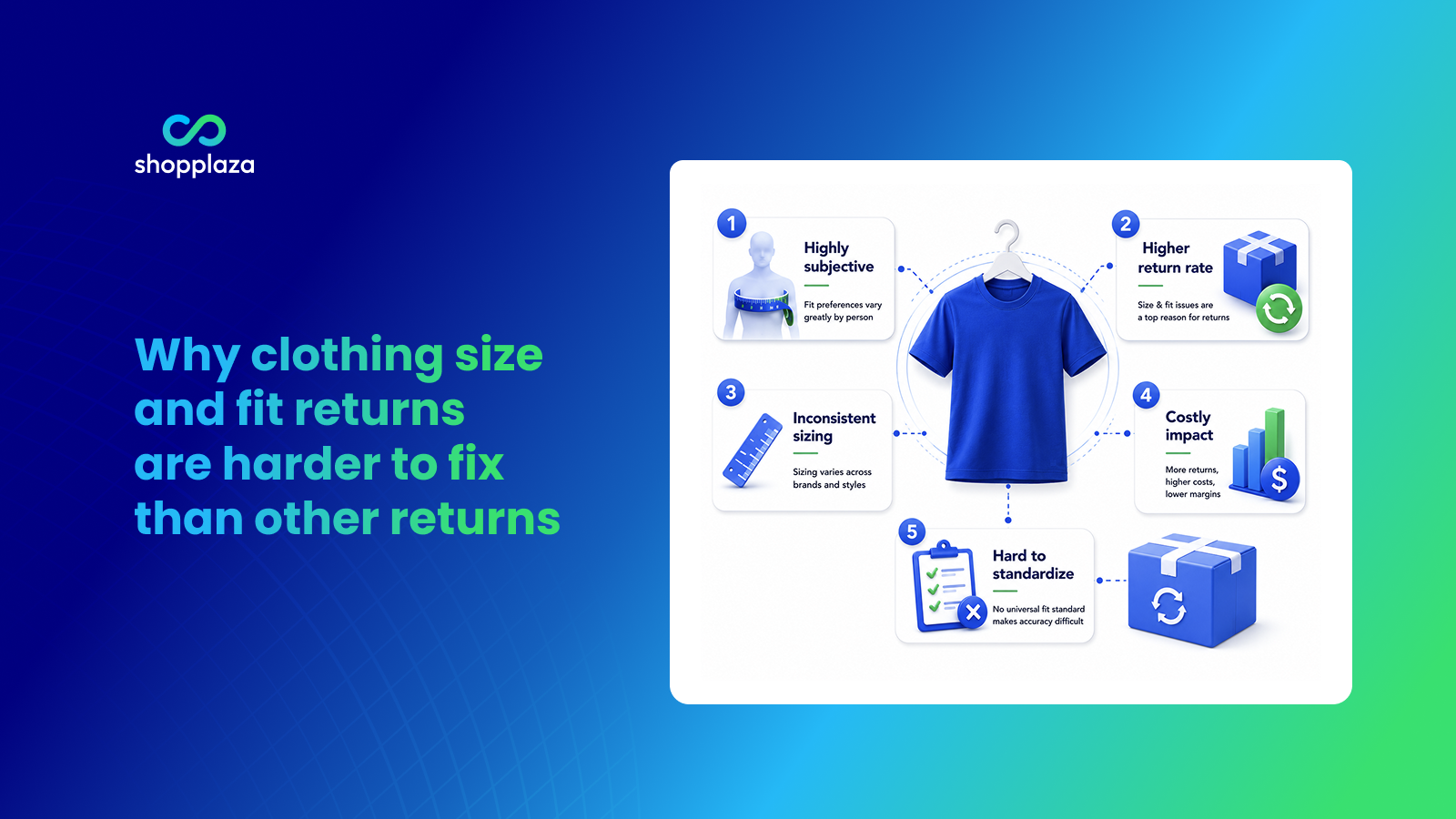
Other categories return for predictable reasons — damaged in transit, wrong item, changed mind. Apparel is different because the same item, ordered by the same person, in the same labeled size, can fit completely differently depending on variables that aren’t visible on a product page.
Vanity sizing and supplier variance
A “size M” from one supplier might fit closer to a UK 10 / US 6. From another supplier, the same “size M” might fit closer to a UK 12 / US 8. Same label, different garment.
If your store sources from multiple suppliers or manufacturers, this gets harder to control. A shopper who confidently bought a size M dress can return the next size M because the cut, fabric, or factory spec is different.
Fabric behavior
A 100% cotton tee doesn’t fit like a cotton-elastane tee, even when the listed measurements are the same. Stretch fabrics forgive small sizing inconsistencies; structured fabrics expose them. Denim, linen, wool coats, non-stretch dresses, swimwear, and formalwear all carry their own fit risks.
That’s why fabric composition shouldn’t be buried at the bottom of the description. It directly shapes the size shoppers should choose.
Body diversity
Static size labels can’t capture how bodies actually vary. Two shoppers who both wear size M may have very different shoulder widths, torso lengths, bust shapes, or hip-to-waist ratios. A chart listing only bust, waist, and hip measurements leaves many fit questions unanswered.
That’s why fit notes, garment measurements, model height, and real customer reviews matter so much in apparel — each layer gives shoppers another way to interpret the fit.
Bodies that change
Repeat customers don’t always know their current size either. A recent Coresight survey (November 2025) found that 72% of US GLP-1 users have dropped at least one clothing size — meaning a meaningful slice of your repeat customers may be mid-transition and not yet sure of their new size. Stronger fit guidance helps these shoppers re-anchor before they bracket.
Style cut differences inside the same store
Your slim-fit shirt and your relaxed-fit shirt may both be labeled “size M,” but they shouldn’t fit the same. A shopper who’s a confident M in one style can feel squeezed in another — or swim in another — if your size guidance treats every cut the same.
This is where many apparel stores quietly manufacture returns: not because they have no size chart, but because they reuse one chart for products that fit very differently.
How to diagnose size and fit returns before fixing them
Before redesigning every product page, find out where your fit problem is actually coming from. A useful diagnostic pass answers questions like:
- Are returns concentrated in a small number of SKUs?
- Are customers mostly choosing “too small,” “too large,” “wrong length,” or “wrong cut”?
- Are slim-fit products returning at a higher rate than relaxed-fit products?
- Are specific suppliers driving more fit complaints than others?
- Do international customers return more often because of size-conversion confusion?
- Are customers ordering multiple sizes of the same product (bracketing)?
- Are pre-purchase support tickets dominated by “what size should I choose?”
- Do products without model height or fit notes return more often than the rest of the catalog?
- Are stretch-fabric items returning less than structured items?
The point is to avoid random fixes. If one product returns because it runs small, fix its fit note and chart. If a whole supplier’s items run inconsistently, push back on the supplier. If bracketing dominates a category, the category needs better fit guidance, model references, and real-fit reviews — not a returns-policy crackdown.
The fit-confidence stack: 7 ways to reduce clothing returns
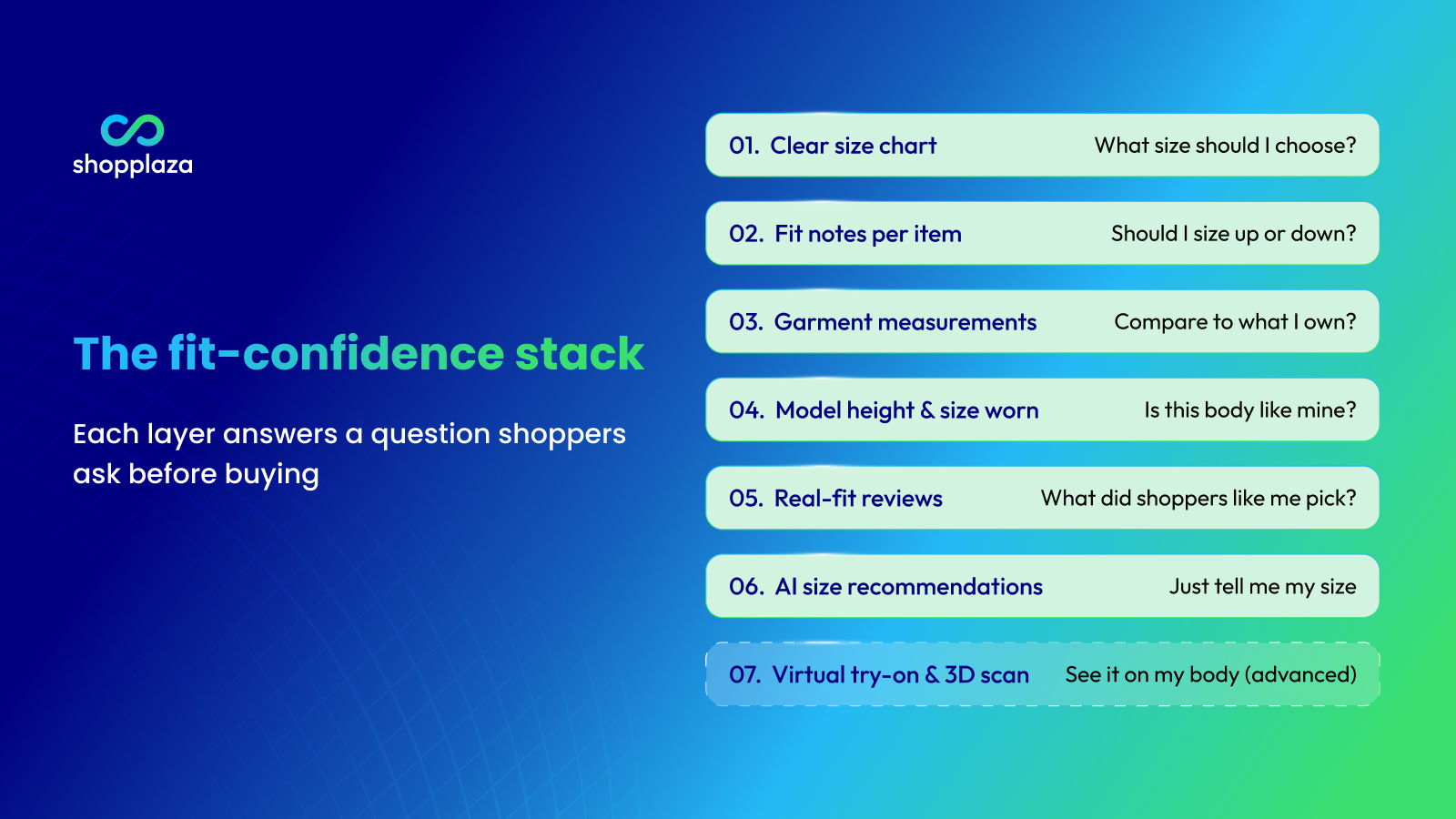
Reducing clothing returns isn’t about bolting on one new widget. It’s about layering enough clarity around the product page that shoppers can confidently answer:
- What size should I choose?
- How will this cut fit my body?
- Does this fabric stretch?
- Is this model’s body similar to mine?
- What did real customers like me choose?
- Should I size up or down?
Each layer below answers one of those questions. Stores that beat the apparel return average tend to do most of them, not just the first one.
Layer 1: A clear, accurate size chart near the size selector
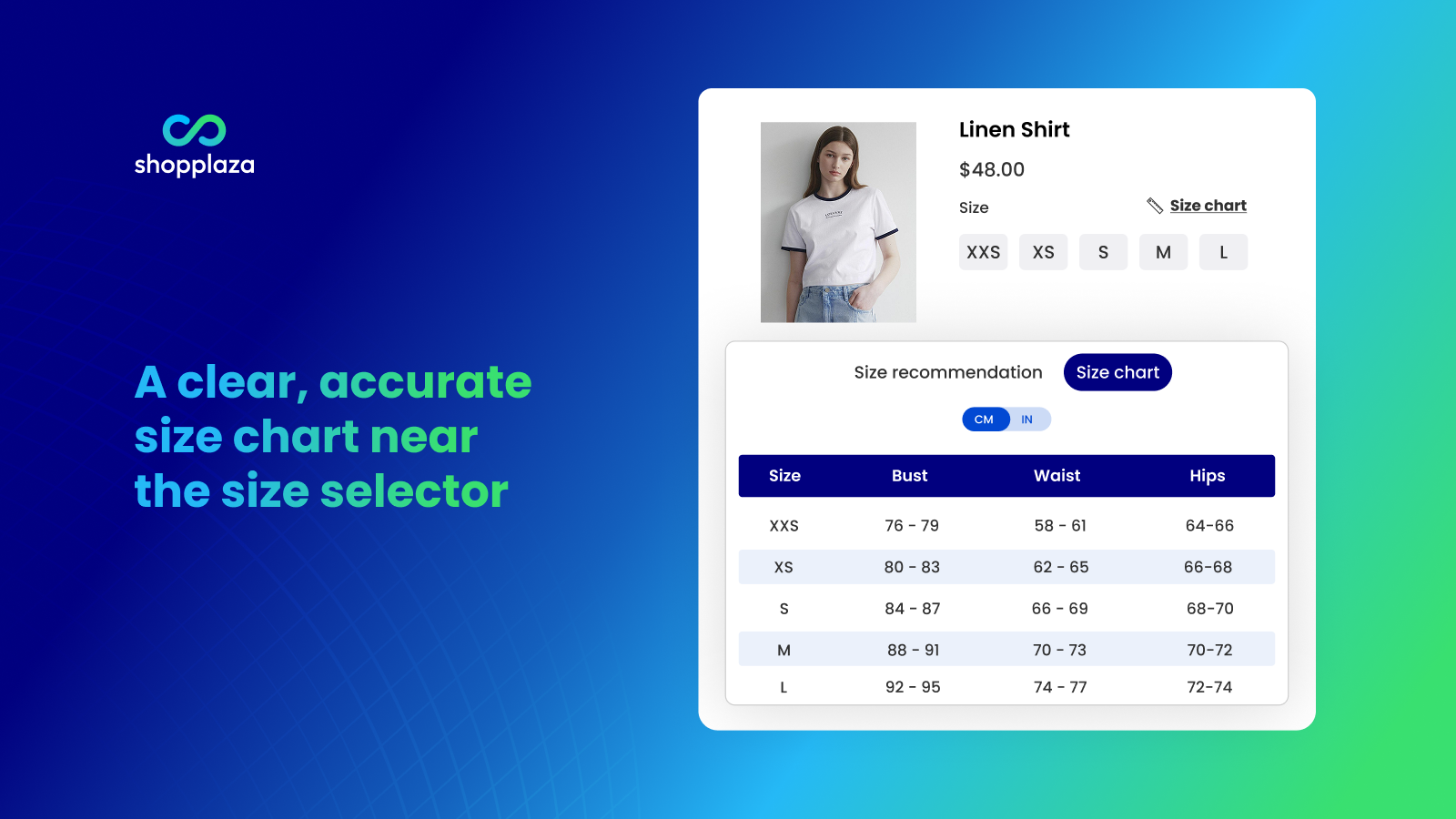
The baseline. A size chart shouldn’t live only in the footer or on a generic “Sizing” page two clicks away. It belongs near the variant picker — as a popup, accordion, tab, or inline section. For the full setup process, see the complete Shopify size chart guide.
A useful apparel chart includes:
- Size labels (XS, S, M, L, XL, etc.)
- Measurements in both inches and centimeters if you sell internationally
- US, UK, EU conversion when relevant
- Both body measurements and garment measurements
- A short “how to measure” note above or below the table
- Fit notes for products that run slim, relaxed, oversized, or non-stretch
A chart alone isn’t the whole answer, but without a clear chart, every other fit layer has a weaker foundation.
Layer 2: Fit notes per item
Fit notes translate measurements into a buying decision. They’re especially useful when products have a specific cut, fabric behavior, or sizing quirk.
Examples:
- “Runs true to size — order your usual.”
- “Runs slim through the bust — if you’re between sizes, size up.”
- “Generous fit — if you prefer a closer cut, size down.”
- “Non-stretch fabric — measure carefully against the chart.”
- “Designed for an oversized look — choose your regular size for the intended fit.”
- “Cropped length — check the garment length before ordering.”
Fit notes work because they remove interpretation work. A shopper may not know what a 96 cm garment bust means in practice, but they understand “runs slim” or “designed to be oversized.” Place fit notes near the size chart link or size selector, not buried in a “details” tab.
Layer 3: Garment measurements, not just body measurements
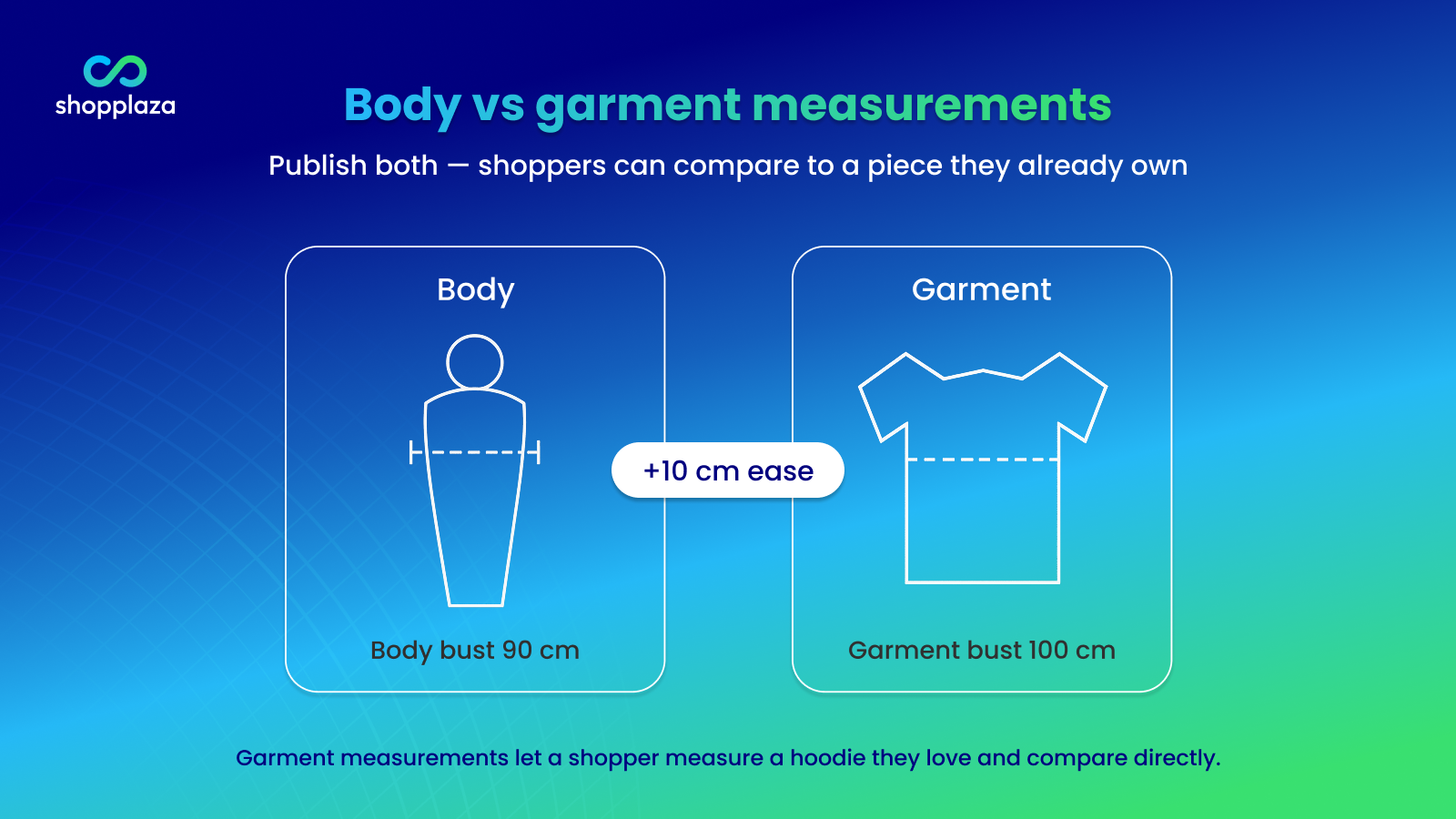
Most size charts list body measurements — what your body should measure to wear this item. Garment measurements show the actual physical dimensions of the finished piece. Both are useful, and publishing both is one of the most underused fit-return reducers in apparel.
| Size | Body bust (cm) | Garment bust laid flat (cm) | Garment length (cm) |
|---|---|---|---|
| S | 86 | 96 (10 cm ease) | 60 |
| M | 90 | 100 (10 cm ease) | 62 |
| L | 94 | 104 (10 cm ease) | 64 |
Garment measurements let shoppers compare your product against something they already own. A shopper can measure a hoodie they love and check its chest, shoulder, sleeve, and length against your chart, bypassing the body-measurement confusion altogether.
This matters most for tops, hoodies, dresses, jackets, jeans, pants, outerwear, and unisex apparel — categories where shoppers benefit from comparing to garments already in their closet.
Layer 4: Model height and size worn (on every photo)
One of the most useful lines on an apparel product page is also one of the simplest: “Model is 5’9” wearing size M.” It gives shoppers a real-world reference point.
Where you can, add more:
- Bust, waist, and hip measurements for the model
- A second model in a different size and body shape (“Model 2 is 5’4” wearing size S”)
- Product length on the model
A dress that looks knee-length on a 5’10” model can land very differently on a 5’2” shopper. A cropped jacket may not look cropped on every body type. A relaxed hoodie may read oversized on one model and regular on another. Model information is one of the lowest-cost, highest-leverage fit improvements apparel merchants can make.
Layer 5: Real-fit reviews on the product page
Photo and fit-feedback reviews are some of the highest-converting AND return-preventing content you can put on a product page — because they come from real buyers, not the brand.
For apparel, the most useful reviews answer questions like:
- How does the fit run?
- What size did you order?
- What’s your usual size?
- What’s your height?
- Did you size up or down?
- Was the fabric stretchy?
- Was the length right?
The pattern that works:
- A reviews app that lets shoppers upload photos
- Structured fit questions (“runs small / true to size / runs large”)
- A fit summary near the top of the review section (“12 of 15 shoppers said this runs true to size”)
- Filters by height, weight, body shape, or size ordered
A shopper who sees “I’m 5’7”, 60 kg, ordered M, perfect fit” from someone with their body shape doesn’t need to bracket two sizes to be sure.
Layer 6: AI-powered size recommendations
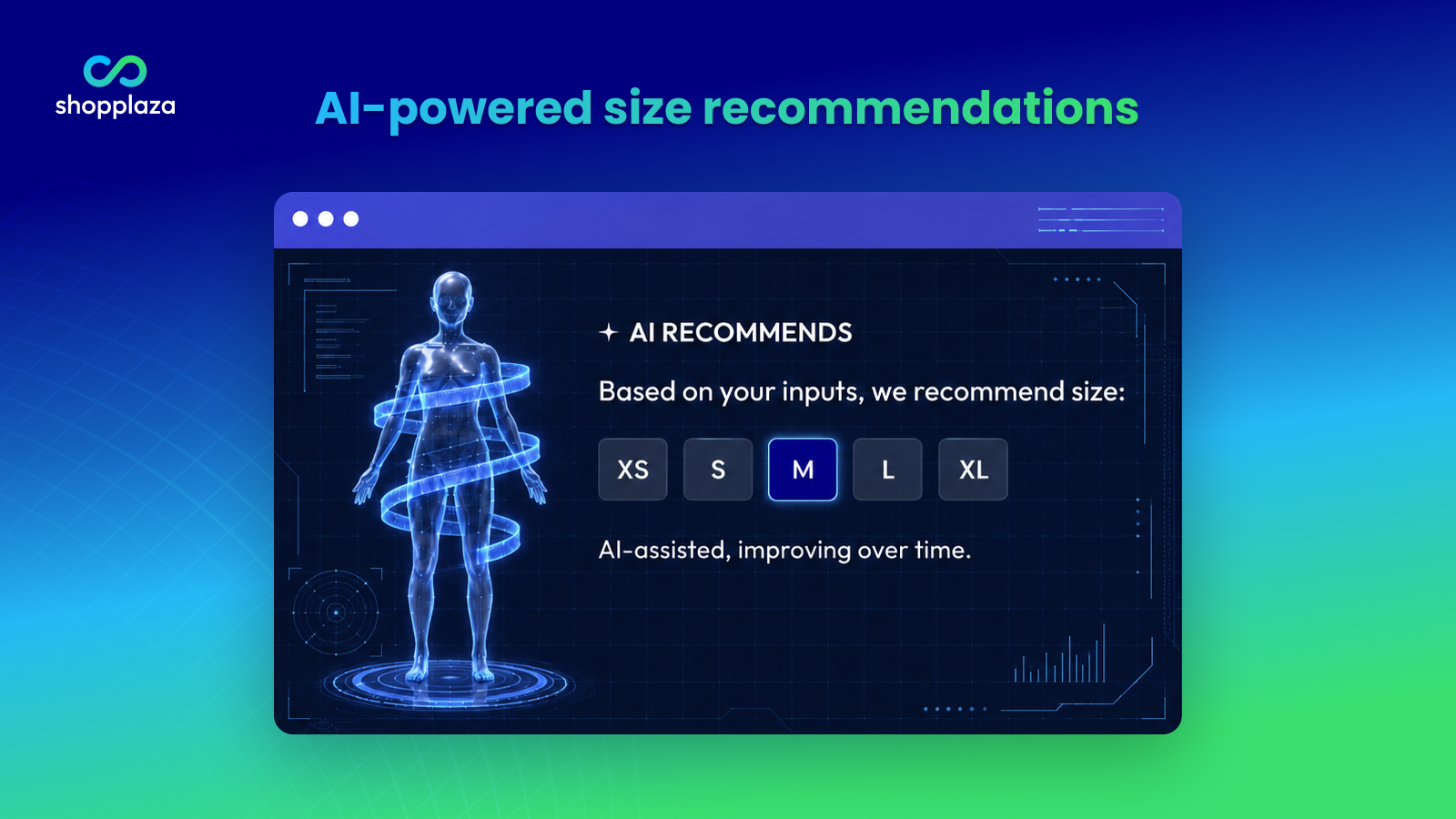
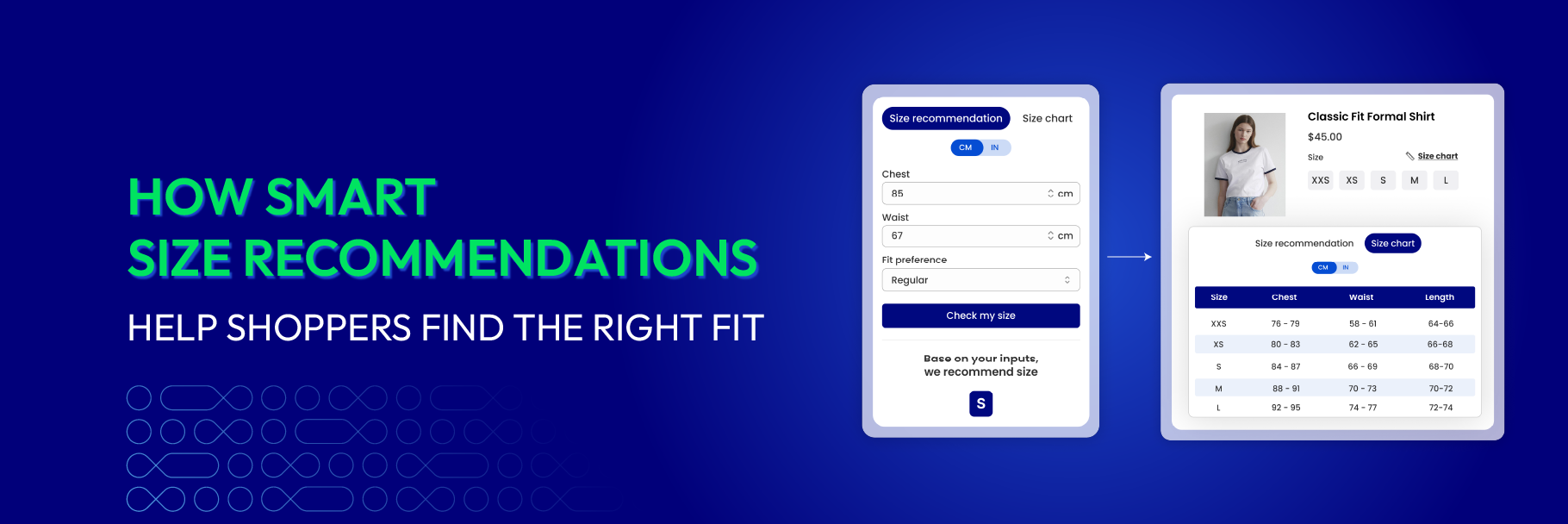
A static size chart tells shoppers the measurements. A smart size recommendation helps them choose.
AI-powered recommenders suggest a specific size for each shopper based on inputs like height, weight, body measurements, fit preference, usual size, or a similar item they already own. They’re especially useful when:
- Customers frequently ask “what size should I get?”
- Products have fit-sensitive cuts (denim, swim, formalwear, lingerie)
- The store sells internationally
- The catalog spans multiple suppliers or brands
- Shoppers regularly bracket multiple sizes
- Average order value is high enough to justify the lift
A recommender shouldn’t replace the size chart. It works alongside it — the chart gives transparency, the recommendation gives direction. On Shopify, MP Size Chart & Size Guide covers layers 1, 3, 4 and 6 from one app, with AI size recommendations (beta) included on its free plan.
Layer 7: Virtual try-on and 3D body scan (advanced)
Virtual try-on and 3D body scanning can move the needle for high-AOV or hard-to-fit categories — denim, formalwear, bras, swimwear, tailored clothing, premium outerwear. They’re not where most Shopify apparel stores should start.
For most apparel stores, layers 1–6 do the bulk of the work. Start at the top of the stack and add layers as your return-reason data shows what’s still leaking.
Style-aware sizing: when “slim” and “relaxed” need different charts
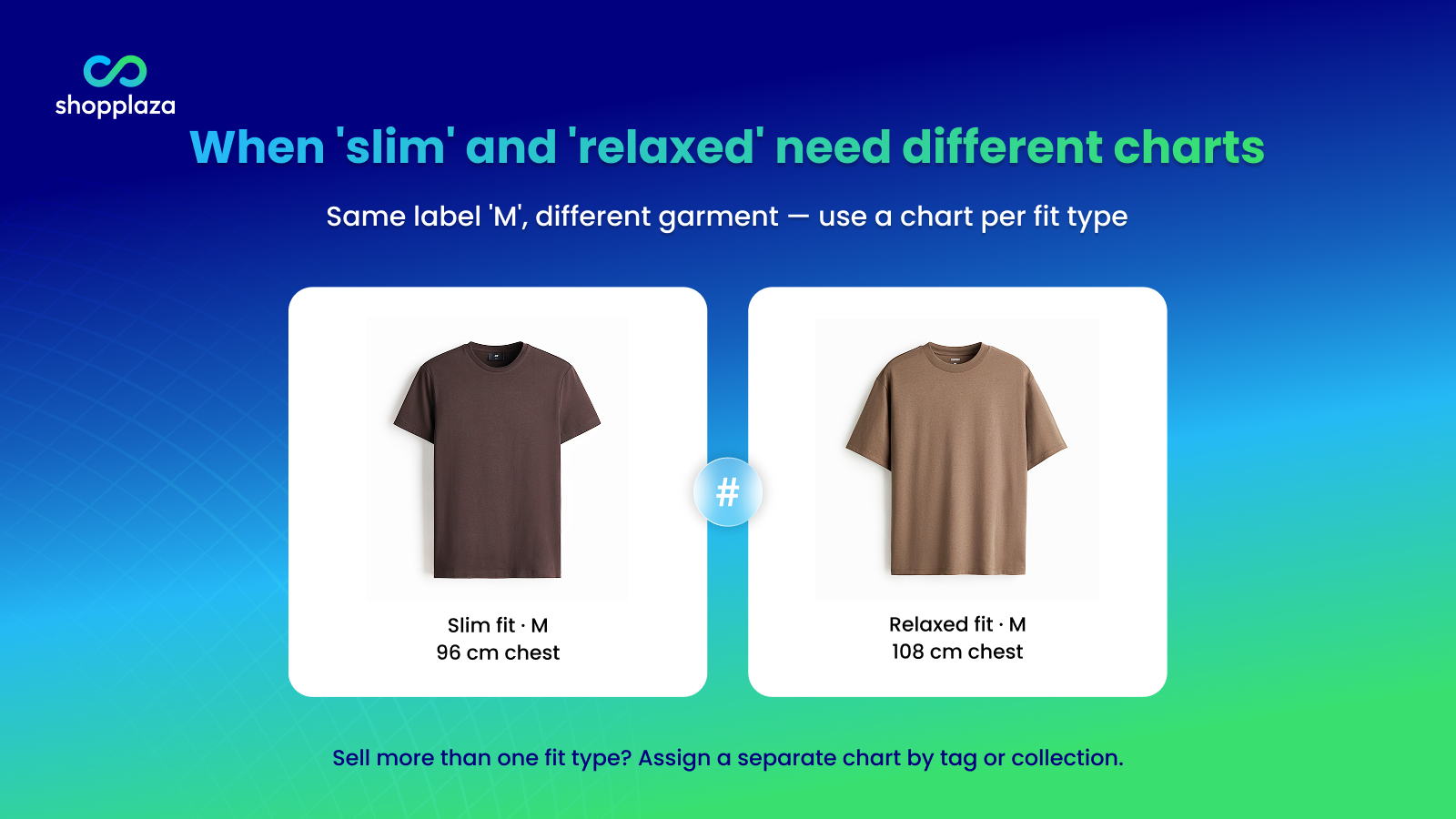
A single generic size chart for every garment you sell quietly creates avoidable returns. A slim-fit shirt and a relaxed-fit shirt in size M can differ by several centimeters at the chest — and a shopper who’s a confident M in one will feel squeezed (or swim) in the other if your guidance treats them as the same.
You can solve this in two ways:
- Multiple size charts — separate charts for slim, regular, relaxed, oversized, petite, tall, or maternity fits, assigned to the right products by tag or collection.
- One chart with fit notes per cut — for example, “For slim-fit items, choose your regular size. For relaxed-fit items, consider sizing down.”
Rule of thumb: if you sell more than one fit type (slim and relaxed, fitted and oversized, regular and tall), use separate size charts per fit type and assign them by tag or collection. A size chart app makes this trivial; a generic single chart quietly costs you returns every week.
This is also one reason manual size charts get hard to maintain as apparel catalogs grow. A small brand with one t-shirt cut can manage with one chart. A multi-category apparel store — dresses, hoodies, pants, outerwear, swim — needs a more flexible setup.
Category-by-category fit traps
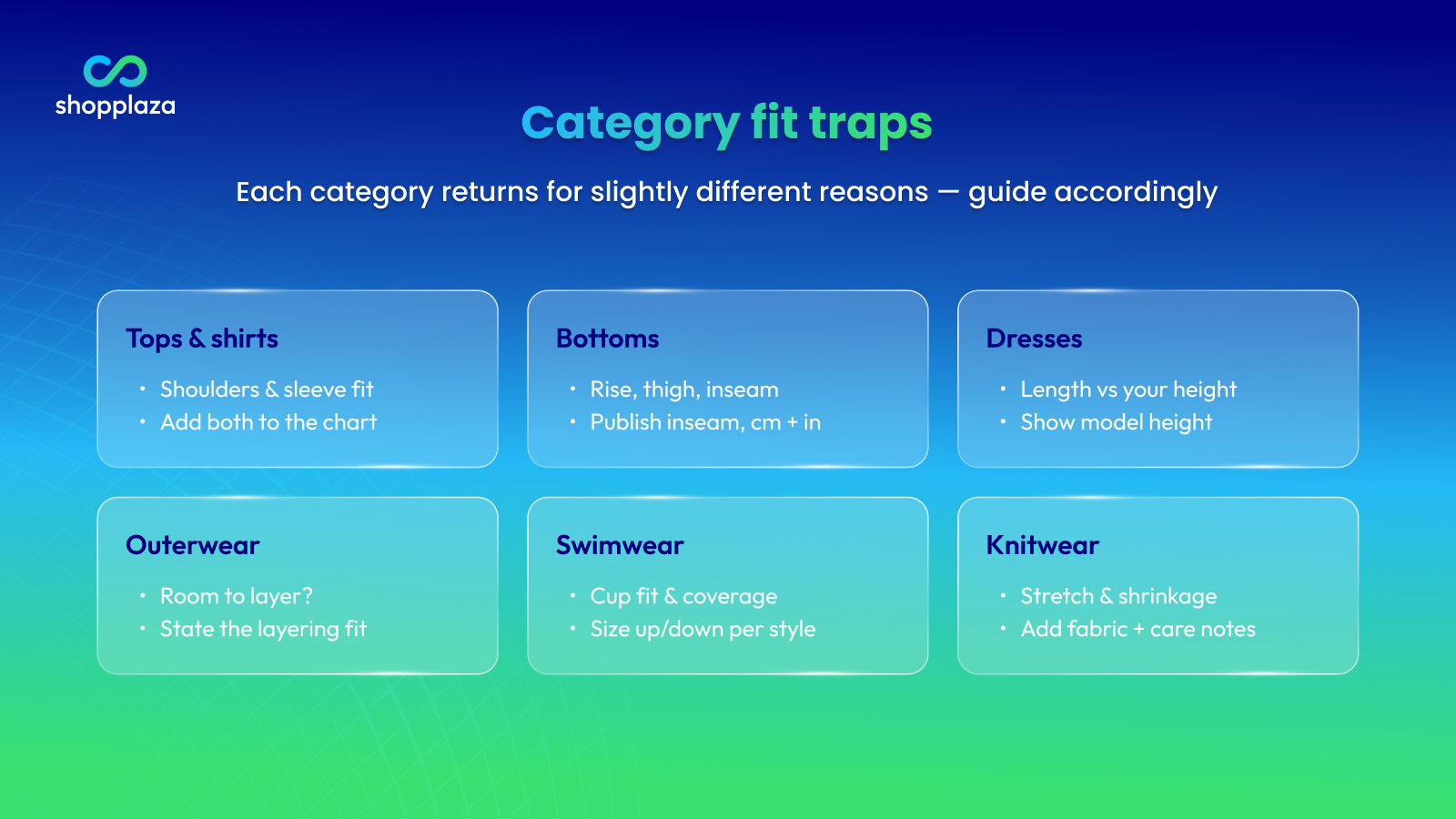
Different clothing categories return for slightly different reasons. The more specific your fit guidance is by category, the easier it is for shoppers to choose the right size.
Tops and shirts
Common return reasons: chest fits but length wrong; tight at the shoulders; sleeve too short or long; fabric has less stretch than expected.
Fix: include chest, length, shoulder width, AND sleeve length in the chart. Add fit notes for fabric stretch and cut. If the shirt is slim or oversized, say so clearly near the size selector.
Bottoms (pants, jeans, shorts)
Common return reasons: waist fits but rise is wrong; thigh too tight; inseam wrong; leg opening doesn’t match expectations; vanity-sizing mismatch with the shopper’s usual brand.
Fix: publish both body and garment measurements — waist, hip, rise, inseam, thigh, leg opening. Always include inseam length in cm and inches. For jeans, separate guidance for slim, straight, relaxed, wide-leg, and high-rise is non-negotiable.
Dresses
Common return reasons: bust fits but waist doesn’t; length is unflattering at the shopper’s height; cut runs short or sheer; dress fits differently from the model image.
Fix: body measurements at bust, waist, hip; garment length from shoulder; model height and size worn on every image; fabric notes for stretch, lining, and opacity.
Outerwear (jackets and coats)
Common return reasons: “I bought my usual size but it doesn’t fit over a sweater”; sleeves wrong length; tight at the shoulders.
Fix: state whether sizing accounts for layering — “slim fit, best over a tee” vs “regular fit, designed to layer over knitwear.” Garment chest, shoulder, sleeve length, and hip measurements.
Swimwear
Common return reasons: cup fit wrong; bottom coverage differs from expectation; fabric runs see-through when wet; support level unclear.
Fix: detailed cup-size guidance for tops, coverage description for bottoms, fabric weight, lining information, and “size up/down” recommendations per style.
Knitwear and stretch fabrics
Common return reasons: “stretched out after one wear”; “tighter than expected”; “shrinks after washing”; behaves differently from the product image.
Fix: fabric composition prominently displayed, care instructions, stretch notes, fit notes like “fits close to body when new and relaxes with wear.”
Set fit expectations before the package ships
A pre-shipment email is an underused fit-return preventer. Most stores use shipping emails only for tracking. Apparel stores can use them to reduce return anxiety and set expectations before the product arrives.
For each apparel order, consider sending:
- A short fit reminder for the specific item ordered — “This dress runs slim through the bust. If you’re between sizes, sizing up usually fits better.”
- A try-on tip — “Try it on indoors first, with the tags attached, in case you’d prefer to exchange.”
- Care instructions — “Wash cold and air dry to help the garment keep its shape.”
- An easy exchange link — “Need a different size? Start an exchange here.”
This won’t stop every return, but it reduces confusion at unboxing — and frames exchanges as easier than refunds, which keeps revenue in your store.
Track size and fit returns separately by SKU
Generic return-rate tracking hides the fit problem. A store may see a 20% overall return rate and assume it has a general returns issue — when in fact the real problem is much narrower: one hoodie runs small, one dress is too short, one supplier’s pants have inconsistent waist measurements, one swim style has unclear coverage.
Set up your returns flow (Shopify’s native returns or an app like Loop or AfterShip Returns) to capture detailed fit reason codes:
- Too small
- Too large
- Too short
- Too long
- Wrong sleeve length
- Wrong inseam
- Wrong cut
- Didn’t fit my body shape
- Bought multiple sizes (bracketing flag)
- Fabric didn’t stretch as expected
Then segment by:
- SKU
- Product type
- Fit type
- Supplier
- Collection
- Country
- Size ordered
- Return reason
- Exchange vs refund
Once a month, export the data and look for patterns. If one SKU runs small, fix its listing first — better fit note, chart, model details, product copy. If multiple SKUs from the same supplier have fit problems, push back on the supplier or relabel the sizing. If a product still returns above 40% after listing and product fixes, consider retiring the SKU.
Common mistakes to avoid
- Using one generic chart for every garment: Different cuts need different sizing guidance.
- Publishing body measurements only: Add garment measurements so shoppers can compare against an item they already own.
- Leaving model height off product photos: Easiest fix on this list. No reason not to add it.
- Hiding fit notes in a “details” tab: They belong near the size chart link or size selector.
- Reusing supplier-default size charts without checking samples: Suppliers often use looser tolerances than your end shoppers expect.
- Treating bracketing as a customer problem only: It’s usually a fit-information problem first. Better layers reduce bracketing without policy crackdowns.
- Making returns harder instead of making the purchase decision clearer: Short windows, hidden policies, or paid returns can reduce request volume short-term, but they hurt trust and repeat purchase.
- Ignoring SKU-level return reasons: If you only track total return rate, you’ll miss the products creating most of the problem.
Conclusion
For apparel stores, cutting returns isn’t a back-end project — it’s a product-page clarity project. The merchants who lower their fit-return rate most don’t add one new tool. They layer in clarity at every moment a shopper asks “will this fit me?” — a clear chart, fit notes, garment measurements, model heights, real-fit reviews, and (where it makes sense) AI size recommendations.
The goal isn’t to make returns harder. It’s to make wrong-size purchases less likely in the first place.
For a real example of this stack working, see how one apparel store boosted conversions and reduced returns with a clearer size guide.
Frequently asked questions
What’s a good return rate for online clothing?
Return rates vary by category, price point, product type, return policy, and customer behavior. Apparel and footwear typically see higher return rates than most other ecommerce categories because shoppers can’t try products on before buying. Coresight Research and Alvanon (2025) put US online apparel and footwear return rates around 23.4%, with size and fit accounting for roughly 70% of those returns. Use external benchmarks as a reference, but track your own return rate by product, category, SKU, and reason code.
Why are clothing returns higher than other categories?
Clothing carries a unique fit risk. Vanity sizing, supplier variance, fabric behavior, body diversity, and style differences all mean two items labeled the same size can fit completely differently. A shopper can’t feel the fabric, try the item on, or compare the fit in person — so if the product page doesn’t answer enough fit questions, they’ll often choose the wrong size, bracket multiple sizes, or return after delivery.
What counts as a size or fit return?
A size or fit return is any return caused by the item being too small, too large, too short, too long, too tight, too loose, the wrong cut, the wrong length, or unsuitable for the shopper’s body shape. It also includes bracketing returns, where a shopper orders multiple sizes of the same item and returns the ones that don’t fit.
What is bracketing in online apparel shopping?
Bracketing is when a shopper orders multiple sizes, colors, or variations of the same item with the intention of keeping one and returning the rest. In apparel, it usually happens because shoppers don’t trust they’ll get the size right. Better size charts, fit notes, model references, real-fit reviews, and AI size recommendations reduce the need to bracket — without forcing policy crackdowns that hurt loyalty.
What’s the single most effective way to reduce clothing returns?
There’s no single fix for every apparel store, but the strongest starting point is usually better fit guidance on the product page. At minimum: a clear size chart near the size selector, fit notes for each product, and model height plus size worn on product photos. For stores with frequent sizing questions or high fit returns, add garment measurements, real-fit reviews, and AI size recommendations.
What should a clothing size chart include?
A useful clothing size chart includes size labels, body measurements, garment measurements where possible, both inches and centimeters, international size conversion when relevant, measurement instructions, fit notes, and product-specific guidance for slim, relaxed, oversized, petite, or tall fits.
Are AI size recommendations worth it for a clothing store?
For stores with diverse customer bodies, fit-sensitive products (denim, swim, formalwear, lingerie), international shoppers, frequent sizing questions, or high size-related returns — yes. AI recommendations take inputs like height, weight, body shape, or a similar item the shopper already owns, and suggest a specific size. They work alongside the size chart, not instead of it.
Should I use one size chart for all my clothing products?
Only if your products share the same cut, fit, and measurement logic. The moment you sell multiple fit types — slim shirts, relaxed hoodies, oversized tees, dresses, jeans, jackets — you should use separate charts or product-specific fit notes. A single generic chart is easier to manage, but it quietly creates confusion when different garments fit very differently.
How do I track fit returns specifically (vs general returns)?
Configure your returns flow to capture detailed size and fit reason codes: too small, too large, wrong length, wrong cut, didn’t fit my body shape, bought multiple sizes. Then review returns by SKU, product type, supplier, fit type, and size ordered. The patterns will tell you which listings to improve, which suppliers to push back on, and which products to retire.
Do supplier-default size charts work?
Usually not on their own. Different suppliers use different tolerances, and the same labeled size can vary across factories or production batches. Measure your own samples whenever possible — especially for best-sellers and items with high return rates — and publish your own numbers. It’s the single fix that prevents the most “wrong size” returns.